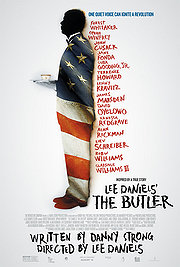
Lee Daniels’ The Butler

butler

Director: Lee Daniels

Writer: Danny Strong

Based On: Article (A Butler Well Served by This Election) by Wil Haygood

Starring: Forest Whitaker, Oprah Winfrey, Terrence Howard, Cuba Gooding Jr., David Oyelowo, Lenny Kravitz

Tomatometer: 72/79/83 (all critics, top critics, audience)

Spoiler-free Summary: Cecil Gaines leaves the cotton farm on which he grew up to become a butler at The White House.  Through eight presidential terms (1952-1986), he witnesses history from the front row.

Two Cents: Oprah Winfrey has not acted in a live action movie (non-animated) since 1998’s Beloved, for which she also served as a producer.  Oprah’s extended hiatus from acting is just one reason she was a curious choice to play Gloria Gaines in The Butler.

Lee Daniels’s latest film is already somewhat famous for having 41 producers.  In essence, that means over 40 individuals contributed some portion of a $30 million, in order to get this movie made.  Surprisingly, Oprah was not one of those people.  Sure, it can be surmised that Oprah didn’t believe in the movie enough to sink her cash into it.  However, I don’t buy that.

I’m not one to spend other people’s money, but $30 million (or any portion of it) is rather insignificant to Oprah.  Plus, with the cast the Daniels was able to assemble, this movie was never going belly up.  My guess is Oprah wanted this opportunity to prove that she can truly act.  She didn’t want to be the kid whose parents donated a library, so he could go to Harvard.  Undoubtedly, Oprah’s commitment to appear in the movie was an important consideration for investors, as her presence all but guaranteed decent box office numbers, but we won’t hold that against her.

I respect Oprah’s attempt at proving her acting legitimacy, but, unfortunately, the queen of daytime television falls short in her role.  Many people believe that talent elevates talent.  For example, a great quarterback can make mediocre receivers look like hall-of-famers.  In many cases, though, talent can differentiate itself like water floating on oil.  In The Butler, the lead roles are inhabited by incredibly talented actors.  Of the three male leads, two have won an Oscar, and the third was nominated for one.  That’s intimidating company for anyone, let alone a woman who’s been sitting on a couch for the last 15 years.  Oprah does a decent job, but she is so outmatched by her screen partners that she overreaches, at times, and comes across as amateurish.

Let’s spend some time talking about the good actors!  Forest Whitaker was mesmerizing in The Last King of Scotland.  Without question, he is one of the most skilled actors of his generation.  In this film, he portrays such an extensive range of emotions, it’s impossible to imagine a role he couldn’t play.  His performance, though understated, is remarkable.

Cuba Gooding Jr. is a tragically underused actor.  Despite an Oscar for his performance in Jerry Maguire and stellar performances in Men of HonorRadio, and others, he only seems to pop up every so often, and almost exclusively in roles that demand an African American male.  He’s too good to spending so much of his time on straight-to-DVD garbage.  Plus, he plays ice hockey!  On the regs!

One of the highlights of this movie is the parade of presidents that wafts through the story.  The performances are, as a whole, pretty darn good.  Liev Schreiber as Lyndon Johnson and John Cusack as Richard Nixon are the most impressive, but the cameos are all fun.

I’m hoping for an Oscar nomination for Debra Denson, the head of the makeup department.  I won’t bet on it, but she deserves one.  She did a superb job with all the characters, especially Oyelowo’s Louis, Robin Williams’s Dwight Eisenhower, and Schreiber’s LBJ.

I recently criticized the lack of realistic racism in 42.  While watching Daniles’s film, I specifically kept my eye out for his treatment of our country’s embarrassing history of prejudice.  As strange as it sounds, Daniels nailed it.  While 42 made me feel bad for Jackie Robinson, having to put up with a few morons, The Butler made me feel disgusted, exhibiting racism as the grotesque, widespread hysteria it truly was.  There’s no question, it was far worse in real life, but Daniels’s depiction of American racism and segregation seems incredibly authentic for a movie with a PG-13 rating.

Should I/Shouldn’t I: The Butler is not a top-flight biopic, and it’s not a thrilling work of historical fiction.  It is, however, a (generally) superbly acted feel-good movie that provides an unprecedented glimpse into the most famous residence in the Western Hemisphere.  The unique view of American presidents offered here is fascinating, if not surprising, and Cecil Gaines’s front row seat to history is reminiscent of Forrest Gump’s.  The script is unremarkable, but the story is quite the opposite.  If you enjoy American history, you’ll appreciate this journey through one of its more dynamic eras.

Sundae Rating: Two scoops with whipped cream
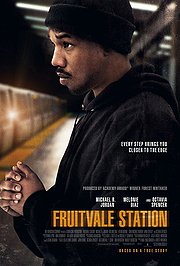
Fruitvale Station

fruitvale

Director: Ryan Coogler

Writer: Ryan Coogler

Starring:  Michael B. Jordan, Melonie Diaz, Octavio Spencer

Tomatometer: 92/90/87 (all critics, top critics, audience)

Spoiler-free Summary: Oscar is a 22-year-old African American man living in Oakland.  He’s got a girlfriend, a daughter, and a criminal record.  Oscar lost his job, so he’s back to selling drugs, but he’s doing his best to become a better husband, father, and man.  He’s really just some guy.  Unfortunately, for a black man, that’s a problem.

Two Cents: There are good movies, there are bad movies, and there are important movies.  Important movies are the ones that tell stories that are difficult to tell, stories that don’t lend themselves to entertainment, stories to which most people would rather turn a blind eye.  Making an important movie takes guts, determination, and investors with no expectation of a return.  It takes a whole lot more than that to make an important movie a really good one, too.  

Fruitvale Station is the true story of Oscar Juliuss Grant, III, a young black man who was the victim of police brutality.  Thanks to social media, his story became a national headline.  This is not a horror film, yet it is most definitely horrifying.  Ryan Coogler (27), in his first feature-length film, does a masterful job of representing Grant as a real and regular person.  By depicting Oscar in many mundane and unspectacular situations, Coogler forces the viewer to root for Oscar, not because he’s special, but because he’s (in many ways) the everyman.  He’s remarkably unremarkable.

Of course, there will be questions about whether Grant really was the person he’s made out to be in this film, and that’s understandable.  I don’t know the answer, and I don’t think it matters.  Police brutality and intolerance are important issues, and this is just one situation that involved both.  It wasn’t the first, nor was it the last.  It probably wasn’t even the first or last on that day, within a two-block radius.

I’m not a political commentator, and this isn’t a political blog.  Still, whether you fall on one side of the discussion or the other, this is a movie that needs to be seen.  Kudos to Coogler and his collaborators for bringing it to life.

Although Grant is the real story here, I can’t understate the power of Michael B. Jordan’s performance.  This young actor is making all the right moves.  He has yet to be less than awesome in any role.  Octavia Spencer is a true pro, and Melonie Diaz continues to build a terrific résumé as a talented character actress.  This film has already won awards at Sundance and Cannes, and I expect it to wrap up a few more before the post-2013 awards season comes to a close.

Should I/Shouldn’t I: Go to a theater, wait for the DVD, or order it on demand – it makes no difference.  Just make sure you see Fruitvale Station.  

Sundae Rating: Two scoops with whipped cream and hot fudge

42

42 poster


HAPPY JACKIE ROBINSON DAY!

Director: Brian Helgeland

Writer: Brian Helgeland

Starring: Chadwick Boseman, Harrison Ford

Tomatometer: 76/70/89 (all critics, top critics, audience)

Spoiler-free Summary: This one isn’t spoiler-free, but I don’t feel bad about it.  Branch Rickey, owner of the Brooklyn Dodgers, helps Jackie Robinson, a young athlete from California, become the first African American to play in Major League Baseball.

Two Cents: Racism is so uncool.

Obviously, Jackie Robinson’s is one of the great stories in American sports history.  As such, there wasn’t really much of a chance for this movie to disappoint.  Still, I applaud Brian Helgeland for taking on the incredible burden of telling such a monumental story.

In general, Helgeland does a wonderful job, handling Robinson’s journey with respect and admiration.  However, I am disappointed with certain aspects of the movie.

For the first hour or so, I couldn’t help but wonder why no character was saying anything inappropriate to Jackie Robinson.  Sure, there were a few stink-eyes, and a slur here or there, but there was nothing that seemed “authentic”.  I don’t want to use the word “thankfully”, so, I’ll say…Appropriately, the racism picks up, halfway through the movie.

I understand that Branch Rickey was a great man, and a champion for civil rights.  In Helgeland’s version of the story, though, Rickey is portrayed as the true hero of the story, instead of Robinson.  Unfortunately, there’s no question that it took a white man to desegregate baseball, but I don’t think it’s fair to compare Rickey’s role in  the phenomenon to Robinson’s.  After all, Rickey makes no effort (at least, during the portion of his life that is covered in this film) to desegregate the bleachers of Ebbets Field.  It just feels wrong to make a white man the hero of a black man’s experience with segregation.  To his credit, though, Helgeland does acknowledge that Rickey (and other MLB owners) had quite a bit of money to gain from desegregating baseball, thereby admitting that, in addition to being a moralist, Rickey was just your average capitalist.

One element in the Jackie Robinson saga, which I found sorely lacking in Helgeland’s film, is the most important element of all – Robinson’s legacy.  Helgeland spends only a few seconds touching on two other African Americans who joined Robinson on the Dodgers in 1948 and 1949.  At no point does Helgeland mention Willie Mays, Ken Griffey, Jr., or any of the other baseball superstars of whom we’d never have heard, had it not been for Robinson’s bravery.  A few statistics, or even a list of names, before the end credits would go a long way.

The acting in this movie is not particularly noteworthy, as Chadwick Boseman and Harrison Ford are really the only actors with a considerable amount of screen time.  Each lead actor does a good job, although, at times, Ford’s portrayal of Rickey crosses the line between acting and impersonation.

Side Note: If you love spotting actors from other movies and television shows, this film is a gold mine.

Should I/Shouldn’t I: I realize I’ve been harping on the negative, a tad, but this movie is very good.  The story is well-known, but you’ll certainly learn something knew about an incredible man and athlete.  If you’re looking for a movie with the triumph and exhilaration of Remember the Titans or Miracle, you won’t find that here, as it’s difficult to capture Robinson’s success in one victorious moment.  You will, however, be uplifted by the courageous and exemplary life of Jackie Robinson.

Sundae Rating: Two scoops with whipped cream